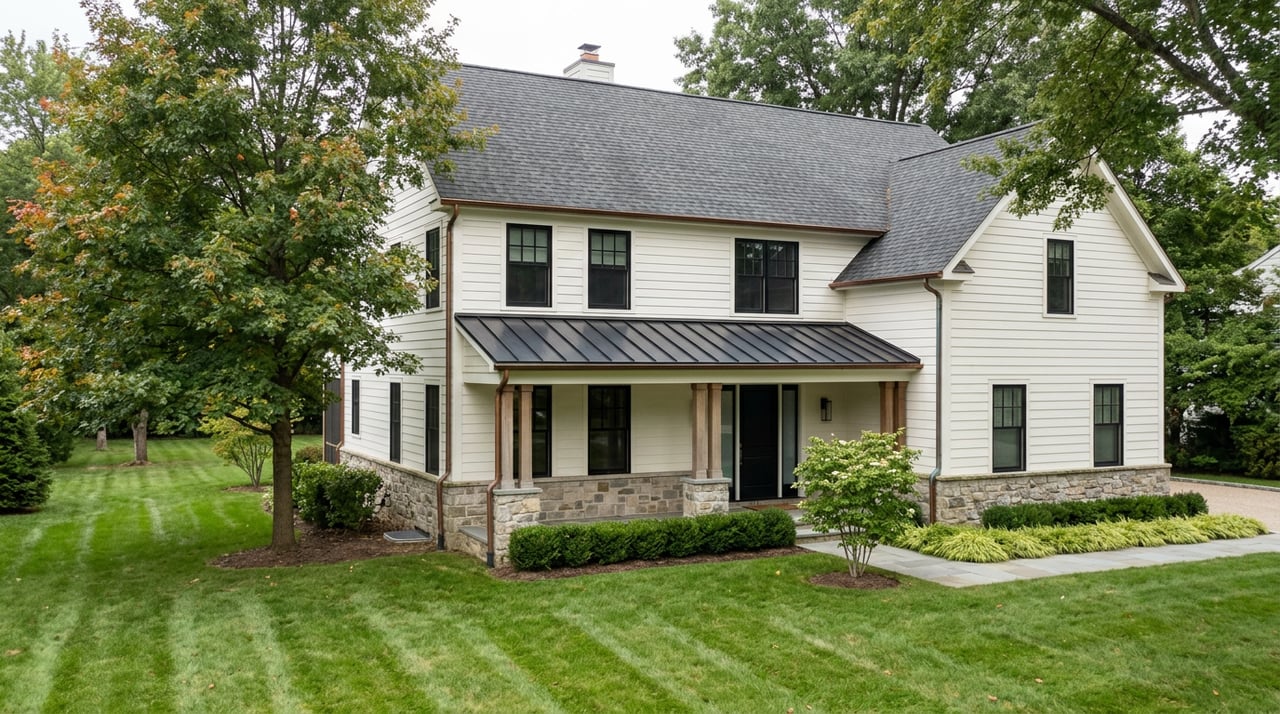
Buyers competing for a home inside Ambler Borough's walkable core know the drill by now: come in strong, come in fast, and be ready to waive something. Over the twelve months ending in March 2026, the median home in the 19002 zip code went under contract in about eight days and sold at an average of 101.54 percent of list price, according to Bright MLS figures. That kind of pace only happens when buyers believe the supply of what they want will not grow.
That belief is about to be tested. Within a half mile of the Ambler Regional Rail station, two separate developers are moving forward with two separate projects that would add close to 400 new residential units to a downtown that has spent the past several years selling itself on the fact that it is small, walkable, and largely built out.
The Premium Is a Scarcity Premium
Ambler's price story only makes sense once you understand what buyers are actually bidding for. The borough's walkable core, Butler Avenue and the blocks around it, gives residents a downtown they can reach on foot: independent restaurants, the Ambler Theater, a SEPTA connection into Center City in well under an hour. Homes with that access carry a real premium over comparable properties in the surrounding township, and the market has been pricing that premium aggressively. Over the three months ending in June 2026, homes in Ambler averaged four offers each and sold in around two weeks, a level of competition that puts the market among the more contested in Montgomery County.
None of that competition is about a shortage of land generally. It is about a shortage of land within walking distance of the station and Butler Avenue specifically. Ambler is an older borough, largely built out, with little room left to add housing stock inside the zone that commands the premium. That scarcity is the entire mechanism behind the eight-day contract window.
Two Landlords, One Half Mile, Two Different Projects
The first project is SEPTA's own. In February 2026, the transit authority's board awarded a 99-year ground lease on its 3.4-acre commuter parking lot at 35 West Butler Pike to Korman Communities and Benchmark Real Estate. The deal pays SEPTA a base rent of $402,500 a year, rising 3 percent annually, for a projected total value near $236 million over the life of the lease. The concept includes ground-floor retail, open space, stormwater management, and a housing mix with an affordable component, with at least 201 commuter spaces retained on site.
The second project is unrelated to the first, run by a different developer on different land. Dresher-based BET Investments has proposed "The Flats at Ambler Station" on the north and south sides of Maple Avenue, near the Wissahickon Avenue crossing at the SEPTA station. That plan calls for relocating an existing office tenant, the engineering firm Hatch, out of roughly 37,000 square feet of space, then building 231 multifamily units and about 5,000 square feet of retail across two buildings connected by a pedestrian bridge over Maple Avenue, with 510 parking spaces. A conditional use hearing on the project is scheduled before the borough on September 15, 2026.
| SEPTA / Korman & Benchmark | BET Investments, "The Flats at Ambler Station" | |
|---|---|---|
| Site | 3.4-acre SEPTA lot, 35 W. Butler Pike | Maple Avenue at the SEPTA station and Wissahickon Avenue |
| Status | 99-year lease awarded Feb. 26, 2026; zoning and design still pending | Conditional use hearing Sept. 15, 2026 |
| Housing | Up to 170 multifamily units, affordable component included | 231 multifamily units |
| Commercial | Ground-floor retail, open space, stormwater management | 5,000 sq ft retail; relocates 37,000 sq ft Hatch office space |
| Parking | At least 201 commuter spaces retained | 510 spaces |
| Distinct feature | 99-year lease valued near $236 million to SEPTA | Two buildings linked by a pedestrian bridge over Maple Avenue |
A SEPTA planning official summed up the thinking behind the first project when the agency's real estate team described "the use of almost five acres of land for just parking" as a missed opportunity, in comments reported by WHYY as the redevelopment plan took shape. The second project reflects a private developer reaching the same conclusion about a different parcel at nearly the same moment.
Why This Needed a Zoning Change First
Neither project could have happened under Ambler's old zoning. The borough's transit-oriented development ordinance used to limit that designation to properties with direct frontage on the railroad tracks, which excluded most of the land now in play. In May 2023, Ambler's council voted to replace that frontage requirement with an 800-foot radius from the train platform. That single amendment brought both the SEPTA parking lot and the Maple Avenue site into the transit-oriented zone, which is what made two independent developers view the same half mile as buildable within a few years of each other.
What New Supply Actually Does to a Scarcity Premium
Here is where the story gets genuinely uncertain, and where a buyer weighing Ambler against a township address needs to think carefully rather than assume the answer.
The intuitive read is that nearly 400 new units should ease the pressure that produces eight-day contracts and over-ask offers. More housing near the station means more options, and more options should mean less desperation. That logic holds in the medium term, but it comes with two qualifications that matter for anyone deciding now.
First, both projects are new construction rental communities, not the twins and colonials that currently make up the bulk of Ambler's for-sale inventory. Renters and buyers are different pools with different budgets and different reasons for choosing a location. New apartments near the station will absorb some of the demand for walkable-core living, but they will not directly compete with a family shopping for a single-family home two blocks off Butler Avenue.
Second, construction takes years, and scarcity does not wait for it to finish. The SEPTA lease was only awarded in February 2026, with design, permitting, and financing still ahead. The BET Investments project has not yet cleared its conditional use hearing. In the near term, the practical effect of both projects is more likely to be construction activity and parking disruption around the station than any meaningful loosening of competition for existing homes.
There is also a case that new retail and a redesigned public realm around the station could reinforce Ambler's premium rather than dilute it. SEPTA's other transit-oriented projects, underway in Conshohocken, Germantown, and Langhorne, are built on the idea that new housing and retail near a station increase ridership and neighborhood vitality together. If that plays out in Ambler, the walkable core gets more walkable, not less desirable, even as it gets bigger.
What This Means If You're Comparing Ambler to a Township Address
- If you are buying in the next twelve to eighteen months, expect the current pace to hold. Two proposed projects do not change today's inventory of single-family homes and twins, and the bidding-war conditions that have defined 2026 are unlikely to soften before either project breaks ground.
- If proximity to the station is your top priority, understand you may be buying next to a multi-year construction zone. That is a fair trade for many buyers, but it belongs in the conversation before you write an offer.
- If you already own inside the walkable core, the medium-term outlook favors you. New retail and a redesigned station area tend to raise the profile of the immediate neighborhood, even while adding rental competition that does not touch the for-sale market directly.
- If your budget points you toward Upper Dublin Township or another surrounding community instead of the borough, the calculus does not change much yet. The premium you are avoiding by looking outside the walkable core is not going away this year. It may shift in three or five years, once both projects are built and leased, but that is a longer horizon than most searches run on.
A Few Quick Questions
Are both projects definitely getting built? The SEPTA lease is signed, but Korman Communities and Benchmark Real Estate still need to complete design, zoning, and permitting before construction starts. The BET Investments project still needs to clear its September 15, 2026 conditional use hearing and any subsequent approvals.
Will this affect parking near the train station? Both projects touch existing commuter parking. SEPTA's plan retains at least 201 spaces, down from roughly 500 today, while the Maple Avenue project would add 510 new spaces tied to its own units. Anyone who parks at the station regularly should expect changes as each project moves through construction.
Ambler's walkable core has commanded its premium because there has been nowhere left to build. That is changing, on two fronts at once, and the buyers and sellers who understand the timeline will be better positioned than the ones who only see the headline about new apartments near the train.
If you are weighing a walkable borough address against a quieter township lot, or trying to time a purchase around what is actually happening at the station, Diane Reddington can walk you through the current inventory, the pricing data behind it, and what these projects are likely to mean for your specific search. Let's Connect.